- The Daily Bite by Snack Prompt
- Posts
- 🍭 Who Owns What AI Knows? 📚


In partnership with


Good morning. Today’s theme is “faster isn’t smarter,” which also applies to group chats, startups, and every decision made after midnight.
Let’s dive in 👇
🍭 What’s Cookin’:
AI models “remembering” copyrighted books (uh oh)
Why AI can’t automate science (even if it speeds it up)
Google’s AI health answers are getting side-eyed
Steal This Prompt
⚖️ Become LawyerGPT: AI Legal Guidance Starter

Turn scary legal situations into structured AI-generated guidance. Summaries, next steps, and a clearer playbook; so you’re less stuck Googling legal jargon and more confident in what to ask next. (Important: not a lawyer; always consult one.)
Perfect for:
folks facing legal proceedings and need clarity fast
entrepreneurs trying to navigate contracts or disputes
anyone who wants a legal knowledge-boosting shortcut before talking to a pro
Workflow:
Click this link (Prompt).
Paste into your AI model
Replace the #s with your legal issue, jurisdiction, and context
Watch AI break down your scenario into usable insights you can act on
Then double-check with a real lawyer

Copyright
☠️ AI May Be “Remembering” Copyrighted Books
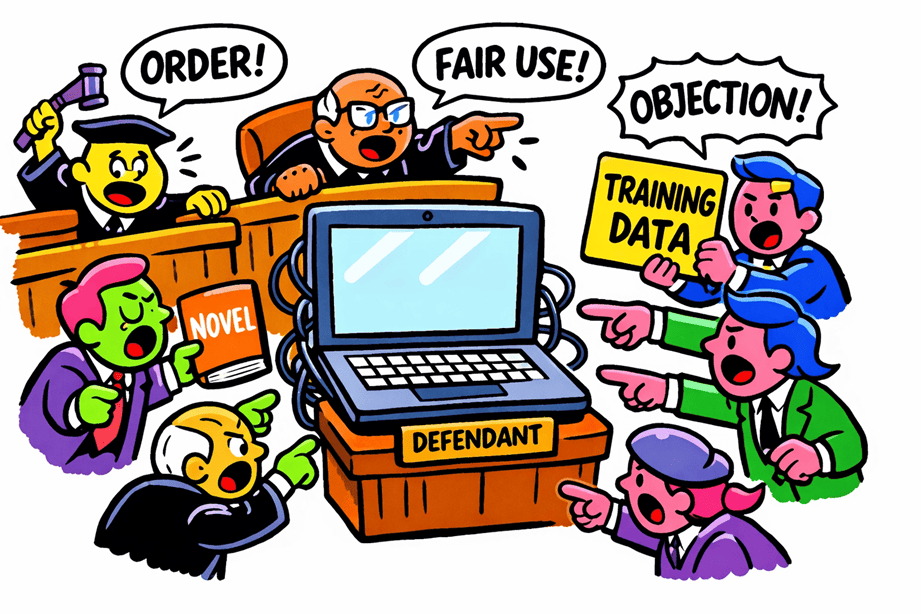
The Bite:
A growing body of research suggests major AI models can reproduce copyrighted books almost word-for-word.
The models don’t summarize or remix them. They recall them.
That’s a problem, legally and ethically.
The findings don’t prove models were trained illegally. But they weaken a core industry defense: that models only learn patterns, not content.
Courts, authors, and publishers are paying close attention.
This won’t stop the AI boom, but it may force a rethink of:
how models are trained
and what counts as “fair use” at scale.
Snacks:
Researchers found models could regenerate long, copyrighted passages when prompted just right
Models from OpenAI, Google, and Meta were tested
The issue isn’t hallucination, but accurate recall
This strengthens ongoing lawsuits from authors and publishers
Training data transparency remains limited across the industry
Why it Bites:
Here’s the uncomfortable part: if a model can recall a book, it’s harder to argue it never “copied” one.
That doesn’t mean AI training is illegal by default.
But it does mean the legal gray zone is shrinking.
AI isn’t going away, but the “scrape everything and sort it out later” era might be.
What comes next likely looks more expensive, more licensed, and more controlled.
Less wild west. More paperwork.
And for an industry built on speed? That’s a real shift.

Hiring in 8 countries shouldn't require 8 different processes
This guide from Deel breaks down how to build one global hiring system. You’ll learn about assessment frameworks that scale, how to do headcount planning across regions, and even intake processes that work everywhere. As HR pros know, hiring in one country is hard enough. So let this free global hiring guide give you the tools you need to avoid global hiring headaches.

ToolBox™
🧰 5 BRAND NEW AI LAUNCHES
🎙️ Typeless 2
Turn natural speech into polished, ready-to-send writing across apps and platforms with context-aware, grammar-fixed AI dictation.
🔍 Ads Research
A WhatsApp-based ad intelligence tool that lets performance marketers instantly discover and analyze live competitor ads from Meta, Google, and TikTok without tab chaos.
📊 Slates
An AI-first presentation primitive built for machine connection protocols (MCPs) that lets agents programmatically create structured, JSON-native slide decks.
📸 Couple AI
A fun AI photo generator that creates high-quality couple portraits or shared images from your photos for memories, gifts, or social posts.
🧠 Free Agent Skill Builder
A tool for instantly building and customizing professional AI agent skills, letting anyone quickly create capabilities their AI agents can perform.

Which image is real?One is real. One is AI. |

Research
🧪 AI Can’t Do Science Without Humans

The Bite:
AI labs are increasingly pitching the idea of “AI scientists”: systems that generate hypotheses, run simulations, and push research forward with minimal human input.
Governments are buying in. So is the public narrative.
But a philosopher of science is calling this a category error made in good faith.
AI can help do parts of science, but science itself is still a human activity.
It is grounded in judgment, debate, values, and shared goals.
AI will change how fast research moves. It won’t change what science is.
Snacks:
AI systems don’t observe the world. They learn from human-built datasets
Tools like AlphaFold work because decades of human knowledge already exist
AI can spot patterns, but struggles with relevance and common sense
Many breakthroughs start as informed judgment, not testable data
Science advances through disagreement, norms, and shared standards
Why it Bites:
Calling AI a “scientist” sounds reasonable because AI now touches so much of the workflow.
But speed isn’t the same as understanding, and pattern detection isn’t the same as knowledge.
For builders and knowledge workers, the real takeaway isn’t “AI can’t help.”
It’s that AI changes the tempo of science, not its meaning.
Without humans deciding what matters, what counts as evidence, and why a question is worth asking at all, science turns into fast computation with no direction.
AI will absolutely accelerate discovery.
But science without humans simply stops making sense.

Everything Else
🧠 You Need to Know
☠️ AI Models May Be Recalling Copyrighted Books
→ New evidence suggests some AI models may reproduce copyrighted text verbatim, reigniting legal concerns over training data and “memorization.”

🏛️ What Responsible AI at Scale Actually Requires
→ Building trustworthy AI systems depends on early governance, transparency, and ongoing human oversight.
🧪 Why AI Still Can’t Replace Scientists
→ AI can speed up research tasks, but science relies on human judgment, creativity, and social debate that machines can’t replicate.

🩺 Google’s AI Health Overviews Are Raising Safety Concerns
→ An investigation found AI-generated health summaries sometimes include inaccurate or misleading medical advice.
🛋️ People Are Using AI to Redecorate Their Homes
→ Homeowners are testing AI prompts to visualize layouts, colors, and furniture before committing to real-world changes.

How was today's Daily Bite? |
— Eder | Founder
— Doka | Editor
Snack Prompt & The Daily Bite
Ticker: FCCN | Trade FCCN Here
Follow Along: FCCN on Yahoo Finance

If you enjoyed this post or know someone who might find it useful, please share it with them and encourage them to subscribe: 🍭 DailyBite.ai