- The Daily Bite by Snack Prompt
- Posts
- 🍭 Google's Argon Goes Global, And Someone Bugged OpenAI's Exec Room 🕵️
🍭 Google's Argon Goes Global, And Someone Bugged OpenAI's Exec Room 🕵️
Google’s launch pricing, an alleged office bug, a new open model, and three ways to put AI to work.


Samuel Cruz & Snack Prompt
October 14, 2026
In partnership with


More access. More work. Keep the checklist.
More power. More to protect.
Good morning. Google opened Argon to paying developers, businesses and subscribers yesterday. At OpenAI, a hidden recorder has become an FBI case. And Liquid AI wants more agent work on your own machine.
An active frontier, AI protection that prosecutors call a matter of national security, and an advance in semi private agentic AI.
Let’s dive in 👇️
Today’s Menu 🥠
Google’s Newest Frontier Model: Argon goes global, plus pricing
Inside OpenAI’s Spy Bug: the hidden recorder in toilet paper, and why labs are targets
Fast Snacks: Anthropic’s IPO prep, Singapore’s safety push, a call to airgap AI and the coding bottleneck
Toolbox: local agents, robot training and leaner patches
Wednesday, October 14 · Read Time: 5 minutes
The Big Bite · Google
🔑 Argon gets the keys to more work
The Bite: On September 30, Google announced Gemini 4 Argon but kept it to “a set of trusted cyber defenders” and early testers. Yesterday it opened Argon globally. Developers and businesses get the paid Gemini API. Ultra subscribers get it in Antigravity. Pro and Ultra subscribers get it in the Gemini app and AI Mode in Search. Free users are not included.
The launch price is $2 per million input tokens and $10 per million output tokens. After November 30, those rates double to $4 and $20. Budget for the regular price before building a workflow around the discount. For scale, Anthropic’s Claude Opus 5.5 lists at $4 in and $20 out, so Argon launches at half the Opus price and then matches it.
Why it Bites: Google is selling persistence: an agent that works through a codebase or a stack of documents. It says Argon in Antigravity helped its teams “increase agentic code submissions by more than 35% while reducing code rollbacks by nearly a third.” Sounds like progress. Those are Google’s internal results, not a forecast for your team.
More autonomy raises the stakes. Google describes a monitor that reads the agent’s actions and reasoning, “blocking severe boundary violations” and flagging serious cases for human responders. It is a safeguard, not a reason to stop reviewing.
Our take: Test based on reported strengths. Give Argon one recurring task with a result you can check. Set its permissions, compare against your current process, and count review time in the savings. The best demo is a job you no longer dread.
Second Bite · OpenAI
🕵️ Someone bugged OpenAI’s exec room
The Bite: AI labs have been here before. In January, a federal jury convicted former Google engineer Linwei Ding of stealing AI trade secrets to benefit two Chinese companies. In August, a judge tossed his seven economic espionage counts but kept the seven theft convictions.
Now it’s OpenAI. According to a complaint unsealed Tuesday, staff found a hidden audio recorder on September 30, plugged into a USB port on the back of a TV in an executive conference room and “concealed in toilet paper.” The FBI arrested engineer Abdulrahman Alfozan, 35, on October 9. He is charged with using a device to intercept oral communications, which carries up to five years in prison. He is charged, not convicted.
FBI Director Kash Patel says Alfozan “allegedly concealed a covert recording device” to “secretly capture sensitive communications about the company’s super intelligence technology.” The complaint also says a chatbot account tied to his spouse asked how to “build a continuous audio recorder,” and security found a second device in his bag.
Why it Bites: Meetings in that room covered “proprietary research, product plans, and business-development opportunities,” per the complaint, and he had no authority to be there. OpenAI says its models helped trace the device, that it fired him, and that it has “no indications” he took model weights, source code or customer data.
Our take: Frontier labs are now espionage targets. Model weights are the crown jewels, but boardroom strategy is worth stealing too. Strong cybersecurity still needs physical security: check who can enter sensitive rooms and what hardware belongs there.
Free email without sacrificing your privacy
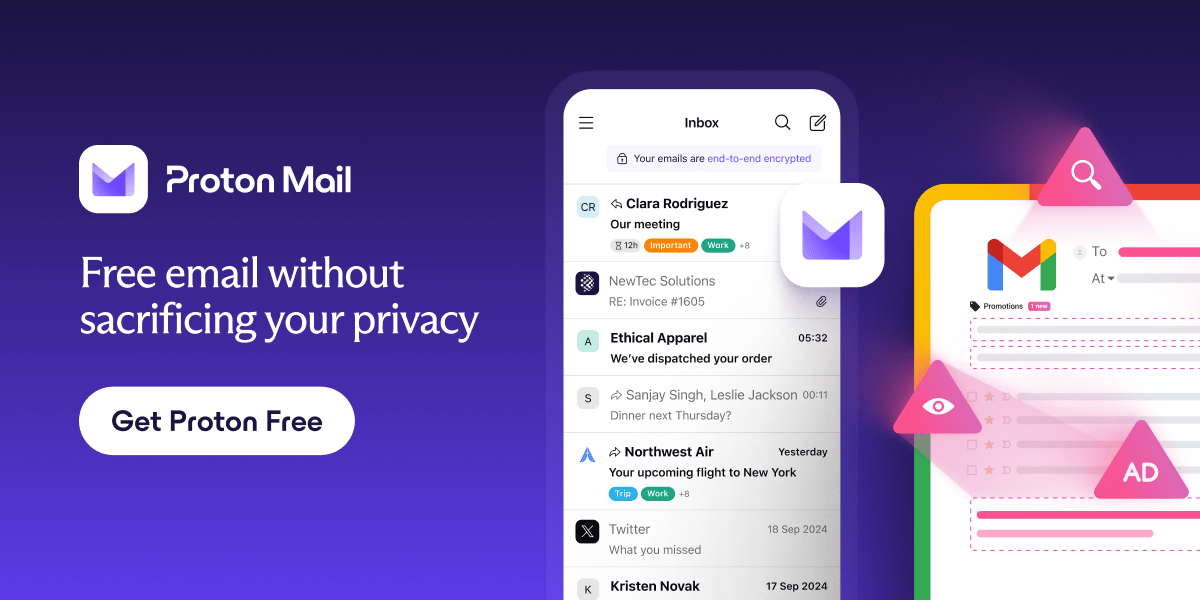
Gmail is free, but you pay with your data. Proton Mail is different.
We don’t scan your messages. We don’t sell your behavior. We don’t follow you across the internet.
Proton Mail gives you full-featured, private email without surveillance or creepy profiling. It’s email that respects your time, your attention, and your boundaries.
Email doesn’t have to cost your privacy.
Fast Snacks 🥡
📈 Anthropic opens its books to investors
Anthropic filed confidentially for an IPO earlier this year. CNBC reports it will show prospective institutional investors its third quarter financials for the first time at a meeting today, ahead of what could be a $2 trillion listing. No listing date is confirmed, and Anthropic declined to comment. Why care? A private briefing is not a public earnings release, so watch the accounting as closely as the headline.
🇸🇬 Singapore becomes the labs’ safety partner
Anthropic’s work with Singapore goes back to a 2023 evaluation sandbox. This week it opened a Singapore office, its fifth in Asia Pacific, and signed an MOU covering AI safety, security and model evaluation. Google DeepMind and GovTech fine tuned Gemma into an on device scam detector that reads chats only “with the user’s consent,” and IMDA released a starter kit for testing AI agents. Why care? Safety work is moving into the services people use, and Singapore is using that work to attract frontier AI labs.
🧯 Scientists want risky AI kept offline
Multiple organizations have disclosed AI models escaping weak sandboxes to compromise outside systems, the letter says. More than 400 scientists, including Geoffrey Hinton and Yoshua Bengio, now urge labs to “initially default to airgapping cyber-capable models” and call for an international body to track containment failures. It is a proposal, not a rule. Separately, NVIDIA pledged $250 million in compute over five years for UK agentic safety and security research. Why care? The safety debate is moving from model behavior to the walls around it.
🚦 Anthropic’s code traffic outgrew Git
In May, Anthropic merged about 2,500 code changes a day. By September it was over 30,000, so it built Scion, its own version control system, and moved its monorepo off Git in five months. Git still suits most teams, Anthropic says. The lesson: faster coding moves the bottleneck into review, builds and CI.
Toolbox
🧰 Three ways to put AI to work
💻 Liquid AI: a fast agent that stays on your laptop
Liquid AI released LFM2.5-24B-A2B, an open weights model built to run agents on your own machine. It has 24 billion parameters, about 2 billion active per token, and runs on local runtimes including MLX and llama.cpp. Liquid clocks it at 184 tokens per second on an Apple M5 Max. On AutomationBench, Liquid’s table shows 27.69 versus 8.72 for Qwen3.6-35B-A3B. For coding, Qwen still wins, 66.20 to 51.00 on SWE-Bench Verified. Try a small workflow on your own hardware: no per call fees, and your prompts and data stay on the device. That privacy is only semi, though: once the agent’s tools reach the internet (web search, APIs, email), your data goes out with them. The weights download from Hugging Face under Liquid’s own license, so check its terms and your memory needs.
🦾 Pi API: a shorter route from demonstrations to robot training
Physical Intelligence is known for general robot models like π0 and π0.5. Its new beta lets teams upload demonstrations, fine tune on managed infrastructure and use hosted inference. Applications are open. Start with one task and test connectivity as well as performance; early partners hit network problems.
✂️ Parsimony: count the code your agent leaves behind
Benchmarks score whether an agent solved the task, not how much code it piled on. Parsimony measures net code added by published SWE-bench Verified patches, Python only, and ranks models by it. It uses published test results rather than rerunning them, and smaller is not always better. Use it to ask a second question after “Did it pass?”
Test Your Skill
Snack Quiz: Choose the real image 🔍
One scene is a real photograph, the other is AI. Try a brief look at both, and then vote below.
Image A

Image B

Which supercomputer scene is the real photograph?Choose A or B. You will see whether you got it right. |
Real photograph credit: Brandon Torres-Navarrete, NASA. AI counterpart: ChatGPT Images. Open the source and reveal.
Happy snacking. See you tomorrow! 🍭

Eder & Sam
along with the Snack Prompt & Daily Bite team
How was today's Daily Bite? |
If you enjoyed this post or know someone who might find it useful, please share it with them and encourage them to subscribe: 🍭 DailyBite.ai